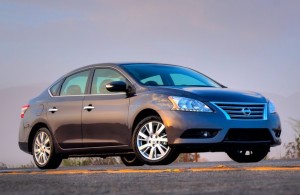
But is it a more appealing car than the smaller and less fuel efficient – but more powerful and sportier driving – car it replaces?
That is the question.
And the answer depends on what you’re looking for.
WHAT IT IS
The Sentra has traditionally been a sporty compact sedan – and thus, a distinct alternative to economy-minded compact sedans like the Toyota Corolla and Honda Civic.
But rising fuel prices – and rising government fuel-efficiency mandates – have put pressure on all automakers to put gas mileage uber alles.
Thus, the bigger-for-’13 Sentra comes with a smaller engine – and less horsepower – but also with a 40 MPG (highway) rating. That’s something the previous Sentra never came close to delivering – unless its engine wasn’t running.

But there’s no performance minded SE-R package – at the time of this review, at least – while there is an FE+ fuel economy package that includes low rolling resistance tires and aerodynamic aids to squeeze as many MPGs (rather than HPs) as possible out of a gallon of ethanol-adulterated “gas.”
Prices start at $15,990 for the base S model with six-speed manual transmission.
A range-topping SL with continuously variable (CVT) automatic transmission starts at $19,820.
The max-effort 40 MPG Sentra FE+ (also with CVT) starts at $17,770.
All Sentras are FWD.
WHAT’S GOOD
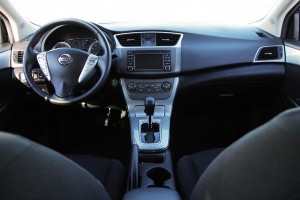
Big enough on the inside to be a family car – if your family isn’t the Duggar family.
Nice enough to not be just another economy car.
A-plus fuel economy – with the CVT transmission.
2013 model starts out $440 lower than 2012 model.
WHAT’S NOT SO GOOD
No longer a sporty car.
C- acceleration with the CVT transmission.
B+ gas mileage with the limited-availability manual transmission.
UNDER THE HOOD
The ’13 Sentra is upsized – but there’s a downsized engine under the hood: 1.8 liters (and 130 hp) vs. 2.0 liters (and 140 hp) previously. This is the same basic engine that’s used in the smaller – and lighter – Versa.
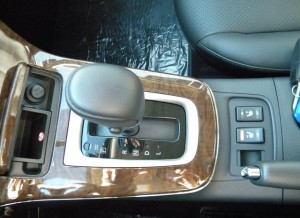
A six-speed manual transmission is standard – but only in base S trim Sentras. All other trims come only with a continuously variable (CVT) automatic, which can be ordered as an a la carte extra for $1,330 with the base S trim.

Even though the new larger model weighs slightly less than the previous model (2,822 lbs. vs. 2,906 last year) the loss of engine displacement – and hp – is evident when the accelerator pedal is depressed: Zero to 60 now takes 9.7 seconds. That’s about half-a-second slower than the old Sentra.
In the car’s defense, several other cars in this segment – among them, the new Dodge Dart and also the Mazda3 – are equally lethargic. However, these two offer engine upgrades that cut the zero to 60 time down into the mid-low 8s – and in the case of the Mazda3, while still delivering exceptionally high gas mileage. The Sentra – so far – comes only with the overtasked 1.8 liter engine – too little engine for too much car.
You’re also virtually forced to buy the CVT automatic, too – at least, if you want something more than a base S trim Sentra – or some of the options that aren’t available in base S trim Sentras, such as the Driver’s package, which adds rear disc brakes (base S trims have drum rear brakes) or the upgrade 17 inch wheel package. These are available only in step-up SV and SR Sentras – and the top-of-the-line SL – which come only with the CVT.
For sport-minded buyers, that’s bad news.
For economy-minded buyers, the good news is the Sentra’s 30 city, 39 highway MPG rating (40 MPG, if you order the FE+ enhancements). This is a dramatic improvement over the 2012 Sentra, which topped out at 27 city, 34 highway. It’s also better by about 4-5 MPG than other economy-minded compact sedans such as the Honda Civic (28 city, 36 highway) as well as the current Toyota Corolla (27 city, 34 highway), Ford Focus (26 city, 36 highway) and Hyundai Elantra (28 city, 38 highway).
The Chevy Cruze, Dodge Dart and Mazda3 can do better – as much as 42 MPG highway, in the case of the Cruze and 41 MPG in the case of the Dodge Dart. But not with their standard engines – and not at a Sentra-equivalent price. To get the 42 MPG Cruze, for example, you’ve got to buy the optional 1.4 liter turbo engine. So equipped, the Cruze’s MSRP is $19,680 – or $2,360 more than the 39 MPG-capable (CVT equipped) $17,320 Sentra S and $1,910 more than the 40 MPG-capable $17,720 Sentra FE+ with CVT.
Same story with the Mazda3. The standard model only manages 33 highway. To get to 40 MPG, you’ve got to buy the optional SkyActive-G engine, which bumps the Mazda’s MSRP to $18,700 – $1,380 higher than the CVT-equipped (and 39 MPG) Sentra S.
And the base ($15,990) Sentra S with six-speed manual still manages 27 city, 36 highway. That’s right there with the figures posted by the Civic, Corolla, Focus and Elantra, slightly better than the base model Dodge Dart (25 city, 36 highway) and a lot better than the base model Mazda3.
Can’t knock that.
ON THE ROAD
Well, here’s something you can.
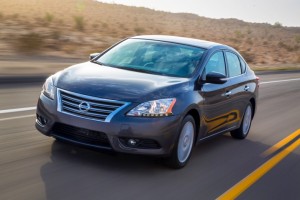
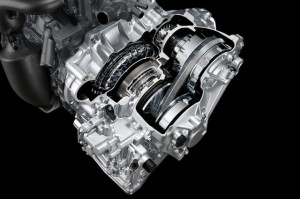
I tested an early production Sentra SL with the CVT automatic transmission – which as mentioned earlier is now the only way you can get an SL or any other 2013 Sentra trim except the base S trim. The CVT is there – and a manual transmission isn’t – in four out of the five available Sentra trims because of the CVT’s efficiency advantage. It’s worth 3-4 MPG at highway speeds, relative to the manual six-speed Sentra – and that’s a big deal not just to potential buyers but also to Uncle, who insists that all new cars average 35.5 MPG by 2016. This pressure accounts for the increasing use of CVTs in numerous cars – and not just Nissans.
The problem is the down-powered, de-engined Sentra is slow – and the CVT transmission only makes it feel slower.
You can’t raise the RPMs and sidestep the clutch – because there is no clutch. And because there’s no torque converter – as in a conventional automatic – the same thing.
It takes longer for an engine mated to a CVT to get into its powerband.
And if the engine is a small engine, the powerband is probably fairly high up in the RPM range – as is the case here. The 1.8 liter’s peak power (130 hp) isn’t produced until 6,000 RPM – vs. 5,100 RPM (and 140 hp) last year. It doesn’t help matters that torque output is also down by 19 lbs.-ft (128 lbs.-ft now vs. 147 lbs.-ft. with the old 2.0 liter engine). The torque peak is more accessible now – 3,600 RPM now vs. 4,800 RPM before. But the bottom line is there’s less power available – and it shows.
Especially with the CVT.
Even though Nissan has done an admirable job in terms of rendering the bigger (longer, more wheelbase, etc.) 2013 Sentra lighter at the curb than the smaller 2012 Sentra, it still weighs a pretty startling (for a compact) 2,822 lbs. – and that’s before the driver gets in. One 180 pound driver and the car is already over 3,000 lbs. Put two passengers in there on top of that and the Sentra’s curb weight will be 3,200 lbs.-plus.
It’s asking a lot of a 1.8 liter engine to get that much mass moving without obvious signs of struggling – and the CVT only serves to call attention to the power deficit by holding the poor little engine at its 6,000 RPM power peak – close to redline – as long as you keep your foot down.
Yes, it’ll get you from A to B – if you’re not in much of a hurry. But forget about passing C. You’ll just have to be patient and wait behind him. Just as others will need to be patient when they’re behind you while you’re trying to get up to speed … or while you’re waiting for room (and time) to risk pulling into traffic.
The Sentra’s CVT does have a Sport (as well as an Eco) setting – but I’d rather have a clutch and the ability to launch a little quicker and cull the drivetrain racket once rolling - even if it cost me three or four MPGs.

I understand why Nissan is hard-selling the CVT. But it wouldn’t be necessary if the Sentra didn’t weigh so much. A 2,500 lb. Sentra could probably hit 40 MPG without the CVT. And with the old 2.0 liter, 140 engine and six-speed manual transmission.
Then it would be fuel-efficient – and still fun.
This one’s not. Acceleration-wise as well as handling-wise.
The new Sentra is a Transportation Unit – like the Corolla and Civic. That’s apparently the target competition now – not sporty new comers like the Dodge Dart and Mazda3 – which appear to be taking over the slot the Sentra used to occupy. And from a business point-of-view, that probably makes sense – because Transportation Units are the volume sellers.
It’s where the money is.
AT THE CURB

The ’13 Sentra edges ever-closer to being a mid-sized car – especially as regards backseat legroom (more on this in a minute).
Nissan probably decided to build a bigger Sentra for two important reasons: To make up for the Sentra’s loss of performance – and to put more distance between the Sentra and its value-priced sibling, the Versa.
The ’12 model Sentra’s interior specifications were virtually the same as the Versa’s (in one area at least – backseat legroom – the Versa had more room than the Sentra). Buyers were probably more willing to overlook the previous Sentra’s slightly cramped interior when the Sentra had more engine and more personality. But now that the Sentra has the same downsized 1.8 liter engine as the Versa?
Time to upsize something else!
Thus, the new car is about two and a half inches longer than the old model and rides on a longer 106.3 inch wheelbase vs. 105.7 inches previously. This makes it look more substantial – and allows for a substantially roomier backseat area: three inches more legroom than before (37.4 inches ) as well as a mid-sized car’s trunk: 15.1 cubic feet vs. 13.1 cubic feet last year.

Also bigger are the front doors.
Actually, they’re huge relative to the rest of the car – and relative to other cars. I got out my tape measure – 44 inches from edge to edge. For a “compact” car, that’s a big door. Some perspective: I happened to have a 2013 Buick Verano sedan the same week I had the Sentra. The Verano – Buick’s entry-luxury sedan – is a bigger car than Sentra – 183.9 inches end to end vs. 182.1 inches for the Nissan. But the Buick’s front doors were three full inches shorter than the new Sentra’s.
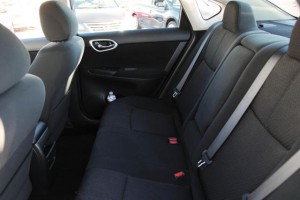
Of course, a big door can be used to create the illusion of space. One that’s sometimes dispelled when you actually sit inside the car. That’s not the case here, though. The new Sentra’s got slightly more front seat legroom than the bigger-on-the-outside Buick (42.5 inches vs. 42 inches) and more backseat legroom than its big (and mid-sized) brother, the Altima (36.1 inches). But what’s really important is that the ’13 Sentra’s got three inches more backseat legroom than the old Sentra (34.5 inches) and about a half-inch more rearseat legroom than you’d get in the value-priced Versa sedan (37 inches).
The ’13 Sentra’s interior, like the rest of the car, is also more lux – and less sport.
The old car’s high-mounted shifter console is gone. In its place, a conventional center console and floor-mounted shifter – available with wood trim covers rather than carbon fiber or brushed metal. Also gone are the previous Sentra’s optional accessory gauges – which had been mounted, 370Z-like, on top of the dash and canted toward the driver.
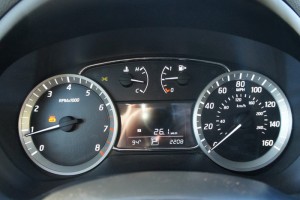
The 5.8 inch LCD screen for the GPS is bigger, too.
An amusing touch is the new car’s 160 MPH speedometer – vs. 140 MPH in the old model.
JATO rockets not included.
THE REST
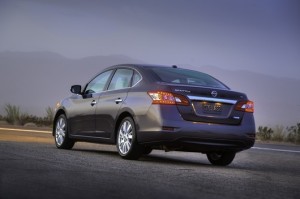
It’s pretty obvious the trend toward smaller, less powerful – and more economical – engines is upon us. Nissan’s just bowing to the inevitable – and trying to make the best of it. In most respects, the new Sentra is a better car than the model it replaces. But it’s also a blander car – and it remains to be seen whether Nissan buyers will be happy about the changeover.
THE BOTTOM LINE
All that’s missing, really, is an underhood upgrade – which may or may not be forthcoming. Probably, not. The market’s just not there anymore.
Meanwhile, the government is.
Please bookmark us

No comments:
Post a Comment